Custom Ring Boxes: Size, Insert and Logo — What to Get Right First
A ring box is small. That is why mistakes show up fast.
There is nowhere to hide a loose ring, a lid that presses on a stone, or a logo too small to read. Get three things right — size, insert, and logo — and the rest is much easier to fix.

1. Size is about the setting, not just the ring
Most people start with ring size. That is only half the question.
A ring box has to clear the highest part of the ring. A low, flat band and a high halo setting need different depths, even if they are the same ring size. If the lid pad touches the stone, the ring will move every time the box is carried.
Send the band width and the setting height, not just the size range. Tell the manufacturer which rings the box has to hold: your thinnest band and your widest band, your lowest setting and your highest. One box can often cover that range, but only if the insert is made for it.
| Ring type | What changes | What to send |
|---|---|---|
| Thin band, 1.5–2.5 mm | Slot needs to grip without tipping the ring | Band width, setting height |
| Wide band, 6–10 mm | Slot needs to be wider, or the ring pops out | Band width, shank shape |
| High halo setting | Box needs more depth, lid must clear the stone | Setting height, stone size |
| A pair | Two slots, with space between them | Both rings, how they should face |
| A stack of thin bands | Wider, flatter slot | Number of bands, total width |
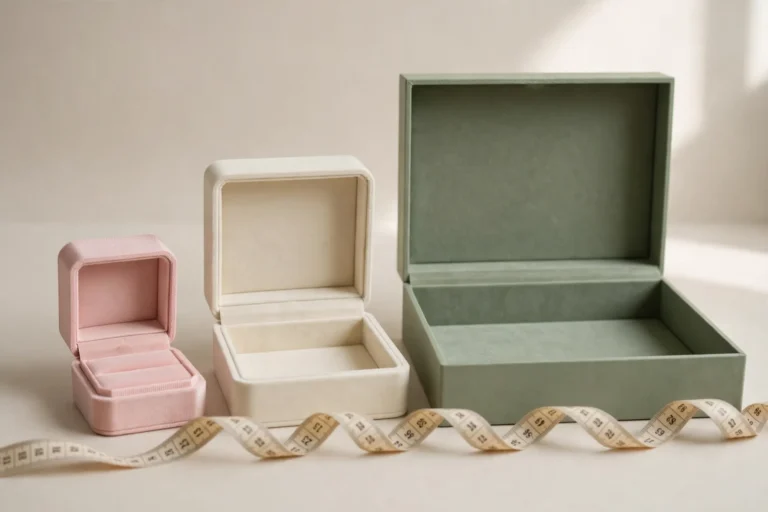
A single ring, a pair, and a stack of thin bands are three different jobs. Decide that before you choose the outside size — the Custom Jewelry Boxes range covers the shapes that fit each job.
2. The insert has to grip, not just hold
A good insert does two simple things: it holds the ring upright when the lid opens, and it lets you lift the ring out without gripping the stone.
That grip comes from the slot, not from pushing the ring in hard. A slot that is right for a thin band will be too tight for a wide men’s band. A slot made for a wide band will let a thin band tip sideways.
This is why we do not start from a standard grid. Send the actual rings, or their exact measurements, and we draw the insert around them. The ring should stand with the stone facing the customer, stay put when the box is moved, and come out cleanly.

| Material | Feel and grip | Best for | Watch out for |
|---|---|---|---|
| Velvet | Soft, holds the ring gently | Engagement rings, gifts | Fine logo lines can fill in |
| Microfiber / satin | Smooth, lighter grip | Fashion rings, sets | Shows handling marks |
| PU leather | Firm, clean edge | Retail ranges, repeat orders | Needs a firmer insert underneath for heavy rings |
| Paperboard | Light, prints well | Volume orders, full-colour lids | Less soft to the touch |
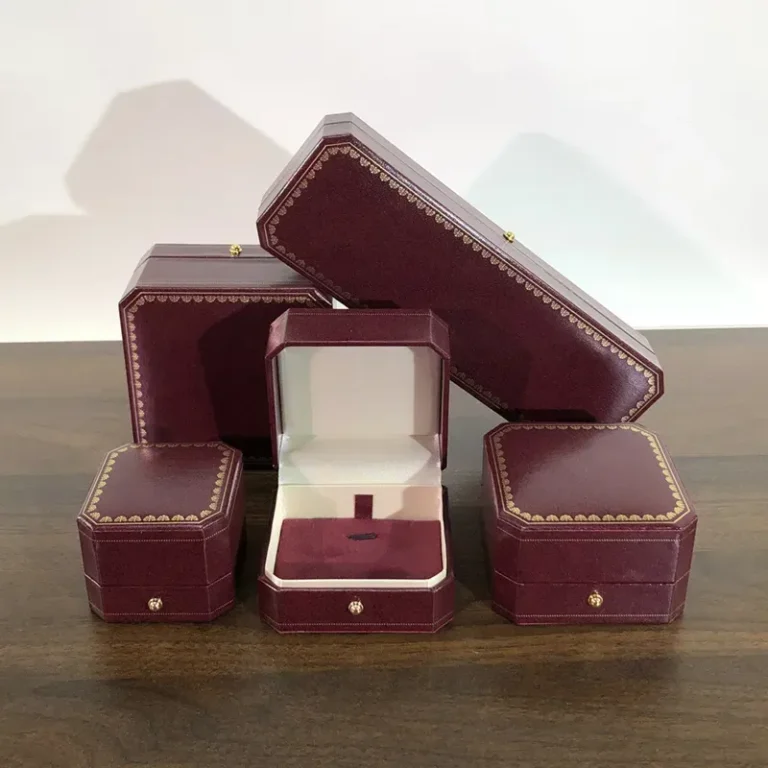
A velvet ring box is the classic choice for engagement rings because it holds the ring softly and photographs well. For a heavier signet, a firmer insert under the fabric works better. Choose the lining with the ring in mind, not just the colour.
The same hold-and-show logic applies to display, where Velvet Jewelry Display Trays keep pieces upright for customers, not just packed for shipping.
3. The logo is small, so keep it simple
On a ring box, your logo is usually only a few centimetres wide. Fine lines, small text, and a lot of detail will disappear.
One placement is enough. Foil stamping on the lid is the usual choice. A debossed mark inside the lid works well too, especially if the outside is already busy. Foil, debossing, embossing, screen printing, laser engraving, and a metal logo all behave differently on velvet, PU leather, and paperboard. What looks sharp on paper can fill in on velvet.
Send vector artwork. A small logo from a website will look fine on a screen and rough in foil. Ask the manufacturer to show you the logo at actual size before sampling, not enlarged on a computer screen. If you cannot read it at that size, your customer will not either.
Keep the colour decision with the logo decision. We keep your approved swatch and dye lot number on file, so a reorder is matched against the swatch you signed off, not against a photo on a screen. That is how a custom jewelry box with logo stays consistent from one order to the next.

4. A two-minute sample check
When the sample arrives, do this before you approve it. It takes two minutes.
| Check | Pass if |
|---|---|
| Thinnest ring, then widest ring | Both stand upright, neither tips |
| Lid closed | Stone does not touch the lid pad |
| Lift the ring out | You lift by the band, not by gripping the stone |
| Closed box on its side, then open | Ring is still in place |
| Logo at arm’s length | You can read it without leaning in |
If any row fails, fix the insert or the logo before bulk production. It is cheaper now than after 500 boxes are made.
5. What to send for a quote
Send band width and setting height, single or pair, box material and colour, logo artwork, quantity per design, and the date you need them. If you have a spec sheet, send it. If you only have a photo of the ring, send that with the measurements.
We make ring box wholesale orders in our own workshop in Dongguan, from 500 pieces per style for custom designs; stock designs start from 10 pieces per style. Samples take 7–10 days, bulk takes 15–25 days, and every order is inspected three times before it leaves.
Start with size, insert, and logo. Get those three right on a sample, and the box will do its job: hold the ring still, show it well, and carry your name clearly — the Custom Jewelry Boxes range is the place to start.